



RESPIRATION project
Investigation of the influence of resonant phenomena of acoustic coagulation in air purification
Implementation period: 26.04.2024 – 25.04.2026
Project manager: Dr Eng. Vladyslav Yuriiovych Shybetskyi
Project acronym: RESPIRATION
Consortium budget: PLN1 005 967,00
Project type: NRC’s research project (POLONEZ BIS-2)
Project location: Łukasiewicz Research Network – Industrial Institute for Automation and Measurements (PIAP)
Awareness-building description of the project:
The aim of the project is to solve the problem of clearing air from fine particles, smaller than 2.5 μm in diameter, by increasing efficiency of acoustic field pre-cleaning technology using resonators.
The pioneering nature of the project is determined by:
- the use of resonators installed in the path of the gas being cleaned of fine particles.
- use of finite element computer modelling to take into account all factors affecting the acoustic coagulation process.
The research objectives are:
- to develop a theoretical mathematical model of a process consisting of three interrelated parts: a model of the oscillation process of resonators represented as rods of complex geometry under the action of high-frequency oscillation; a model of the process of propagation of high-frequency oscillations in a continuous medium (air) through resonators; a model of the movement of fine particles in air under the influence of high-frequency vibrations and their interaction with resonators;
- to develop a complex computer model of the process of propagation of high-frequency oscillations in an acoustic environment (air) through resonators of different designs in the ANSYS analysis system, consisting of three interrelated parts: development of a computer model of the process of propagation of high-frequency oscillations in the acoustic environment (air) through resonators of different designs; development of a computer model of the hydrodynamics of air movement with dispersed particles through resonators of different designs; development of a natural vibration model of the acoustic coagulation system and the occurrence of resonance in it;
- to investigate the effect of high-frequency oscillations by resonators of optimised design on the quality of air purification by means of a physical experiment. Determining the correctness of the influence of the granulometric composition of fine particles, their concentration, mass and nature on the treatment process;
- verification of data obtained from modelling and physical experiment;
- optimisation of the resonator design to increase coagulation efficiency;
- to carry out technology scaling and experimental studies of the feasibility of using mobile devices of air purification systems based on acoustic coagulation combined with robot autonomy to eliminate smoke and high concentration of fine particles in a confined space for rescue operations;
- to disseminate the project’s results by publishing them in high-impact publications and describing the results at international conferences; create a website; conduct seminars; and publishing the results in “Cordis” and “Horizon” journals.
Mathematical modelling methods based on the equations of orthokinetic theory, hydrodynamics of fluid motion (Navier-Stokes equation) and acoustic excitation theory will be used to develop a theoretical mathematical model. Computer simulations will be carried out using the finite element method of the ANSYS analytical system. It is planned to use the principles of three-dimensional modelling using CAD software to build geometric research models.
The study of resonance phenomena is planned to be carried out in two stages:
- determination of natural frequencies by vibration-modal analysis (ANSYS)
- determination of resonance manifestations in the solidification system by the Acoustic Response method – Acoustic Response (ANSYS)
The effect of resonators on gas flow hydrodynamics will be determined using Fluent computational hydrodynamics (ANSYS): the movement of the gas is described by the Realisable K-e turbulence model; fine particle trajectories are provided by the Discrete Phase model. The project provides for a quantitative analysis of the research results. The result of the computer simulation will be plots of variables, contours, vectors, trajectories of particle movement and values of particle number, pressures, velocities. The experimental study determined the number of particles after air treatment, the pressure loss in the system, and the energy consumption to generate oscillations. All these parameters will be a primary information. They will be recorded by
It is planned to use regression analysis to process the experimental data and establish relationships between their values.
Contact details:
Implementing entity: Łukasiewicz Research Network – Industrial Institute for Automation and Measurements (PIAP)
Address: Al. Jerozolimskie 202, 02-486 Warszawa
Project manager’s e-mail: v.shybetsky@gmail.com
SUMMARY OF THE COMPLETED PROJECT
PROJECT ACHIEVEMENTS
Key Results:
- developed a mathematical model describing the interaction of sound with fine airborne particles
- research showed that acoustic resonators can increase the number of captured particles by 6.8 times while simultaneously reducing air flow resistance by 40%
- developed three application concepts: for clean rooms (pharmaceuticals, electronics), an autonomous system, and a portable module for mobile platforms
- submitted a patent application for “Ultrasonic Module for Aerosol Pre-Coagulation”
- successfully passed the first evaluation stage of FENG Proof of Concept grant (€ 688,548) for technology commercialization
Experimental Test Bench:
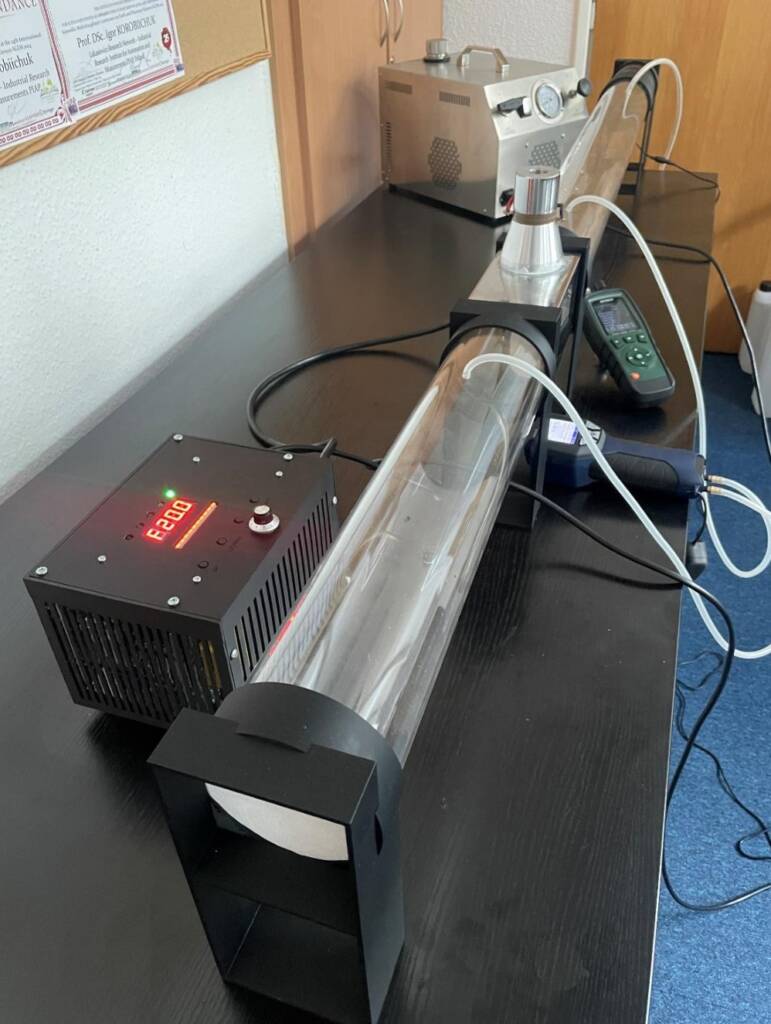
- built an experimental setup at PIAP to validate modeling results
- configuration: 90×90 mm stainless steel chamber, laser particle counter, differential pressure gauge, aerosol generator
- conducted full factorial experiments with four operating modes, three flow rates, and three contamination levels
SCIENTIFIC PUBLICATIONS
- Shybetskyi V., Korobiichuk I. et al.. Classification and Comparative Analysis of Acoustic Agglomeration Systems for Fine Particle Removal. Applied System Innovation, 2025, 8(4), 116. DOI: 10.3390/asi8040116. https://doi.org/10.3390/asi8040116.
- Shybetskyi V., Korobiichuk I., Kalinina M., Kostyk S., Khyzhna D.. Oscillation-Induced Inertial Capture of PM2.5 Particles by Pre-Tensioned Resonating Rods. In: Proc. 11th World Congress on Civil, Structural, and Environmental Engineering (CSEE 2026), Paris, April 2026. DOI: 10.11159/iceptp26.170. https://doi.org/10.11159/iceptp26.170.
- Shybetskyi V., Korobiichuk I., Kalinina M., Khyzhna D., Shopova Z.. Modeling of Ultrasonic Emitter Surface Oscillations for Ultrasound Enhanced Processes. In: Szewczyk R., Zieliński C., Kaliczyńska M., Bučinskas V. (eds) Automation 2025: Recent Advances in Automation, Robotics and Measurement Techniques. AUTOMATION 2025. Lecture Notes in Networks and Systems, vol 1687. Springer, Cham, 2026, pp. 94–105. DOI: 10.1007/978-3-032-08359-3_9. https://doi.org/10.1007/978-3-032-08359-3_9.
- Shybetskyi V., Korobiichuk I.. Mathematical modeling of acoustic impact on airborne particles through resonators. In: Proc. 1st International Scientific and Practical Conference “Artificial Intelligence and Information Technology” (AIIT-2024), Kyiv, June 2024. Zenodo: https://zenodo.org/records/16794305.
- Shybetskyi V. et al.. Ultrasonic pre-treatment for enhanced air filtration in pharmaceutical cleanrooms. In: Proc. XIXth International Scientific and Practical Conference “Biotechnology of the 21st Century”, Kyiv, May 2025. Zenodo: https://zenodo.org/records/16794519.
- Shybetskyi V., Korobiichuk I., Kalinina M., Khyzhna D., Shopova Z.. Numerical Analysis of Resonator Configuration for Acoustic Agglomeration. In: Proc. XXVIth International Multidisciplinary Scientific GeoConference SGEM 2026, Albena, Bulgaria, July 2026.
- Korobiichuk Zh., Korobiichuk I., Shybetskyi V.. Prospects for the Development of Fine Particulate Matter Filtration Systems. In: Proc. XXVIth International Multidisciplinary Scientific GeoConference SGEM 2026, Albena, Bulgaria, July 2026.
- Shybetskyi V., Korobiichuk I., Kalinina M., Nowicki M., Kostyk S., Khyzhna D.. Numerical Investigation of PM2.5 Particle Dynamics in an Air Duct with Vibrating Plate Resonators under Ultrasonic Excitation. Submitted to Frontiers in Environmental Science. https://www.frontiersin.org/journals/environmental-science.
CONFERENCES AND SCIENTIFIC EVENTS
- AIIT-2024 – 1st International Scientific and Practical Conference “Artificial Intelligence and Information Technology” (Kyiv, Ukraine, 3–4 June 2024) http://kist.ntu.edu.ua/konferencii/49_konf_2024.pdf
- Automation 2025 (Warsaw, Poland, 7–8 May 2025) https://automation.piap.pl/historia/automation-2025/
- Biotechnology XXI Century – XIXth International Scientific and Practical Conference (Kyiv, Ukraine, 16 May 2025) https://www.biotech.kpi.ua/en/conference-biotechnology-xxi-century/conference-2025
- CSEE 2026 – 11th World Congress on Civil, Structural, and Environmental Engineering (Paris, France, 16–18 April 2026) https://2026.cseecongress.com/
- SGEM 2026 – XXVIth International Multidisciplinary Scientific GeoConference (Albena, Bulgaria, 4–13 July 2026) https://www.sgem.org/
SCIENCE COMMUNICATION AND EDUCATION
Public Science Articles:
Medium: https://medium.com/@v.shybetsky/ (January 2026)
Substack: https://open.substack.com/pub/vladyslavshybetskyi/ (April 2026)
Innovation Competitions:
- XIV International Innovation Festival “Sikorsky Challenge 2025” (project: AirSonic, status: finalist, dates: 28 October – 3 November 2025, location: Kyiv, Ukraine, award: Diploma of Finalist)
Educational Integration:
- ANSYS models from the project integrated into National Technical University of National Technical University of Ukraine “Igor Sikorsky Kyiv Polytechnic Institute” course “Modeling of Biotechnological Processes in Specialized Equipment”
- students study real examples from the RESPIRATION project
- master’s student Zlata Shopova (National Technical University of National Technical University of Ukraine “Igor Sikorsky Kyiv Polytechnic Institute”) participated as co-researcher throughout the project
COMMERCIALIZATION AND PARTNERSHIPS
Submitted and Prepared Grants:
| Programme | Grant Number | Status |
| FENG Proof of Concept (FNP) | FENG.02.07-IP.05-0076/26 | Formal evaluation passed (11.06.2026), merit evaluation in progress |
| NATO Science for Peace and Security | G10635-MYP | Submitted, not approved |
| OPUS32 NCN | In preparation | Planned submission autumn 2026 |
Partnerships:
- VP Euro Corporation B.V. (Netherlands) – Intersectoral secondment to understand practical requirements of industrial ventilation
Description of Project Results for General Public


Research carried out under project number 2022/45/P/ST8/03621 co-financed by the National Science Centre and the European Union Framework Programme for Research and Innovation in the field of research and innovation “Horizon 2020”, under contract 945339, within the framework of the “Marie Skłodowska-Curie” measures